


Bark mulches are widely recommended for gardens and landscapes, but understanding how they work is the key to choosing and using them well.
This article focuses on coarse, freely draining bark mulches used on garden borders and landscaped areas. It explains what bark mulches can do, what they cannot do, how to choose the right type, and how to use it effectively. Finer, more nutritious mulches will be covered in a future blog.
The principal benefits of bark mulches are that they suppress weeds and conserve moisture in the soil. Secondary benefits include a gradual improvement of organic matter in the soil, soil temperature regulation, a better appearance and protection against soil compaction and erosion.
Weed suppression
It’s well known that bark mulches can suppress weeds but how do they do this?
Many weed seeds need light to germinate, hence the flush of seedlings observed after cultivating the soil. Cultivation brings seeds to the surface so a mulch, whatever it is made from, will prevent light getting to the weed seeds thus helping to suppress their germination.
Airborne weed seeds landing on a coarse bark mulch are presented with a hostile surface so even if they do manage to germinate, they find it difficult to thrive. Hostile because it is very freely draining and therefore dry, even very quickly after rainfall. So a mulch used primarily for weed suppression will be far more effective if it has few fine particles. Fines only serve to allow the mulch to hold more moisture and therefore present a less hostile surface on which weed seeds can successfully germinate and develop.
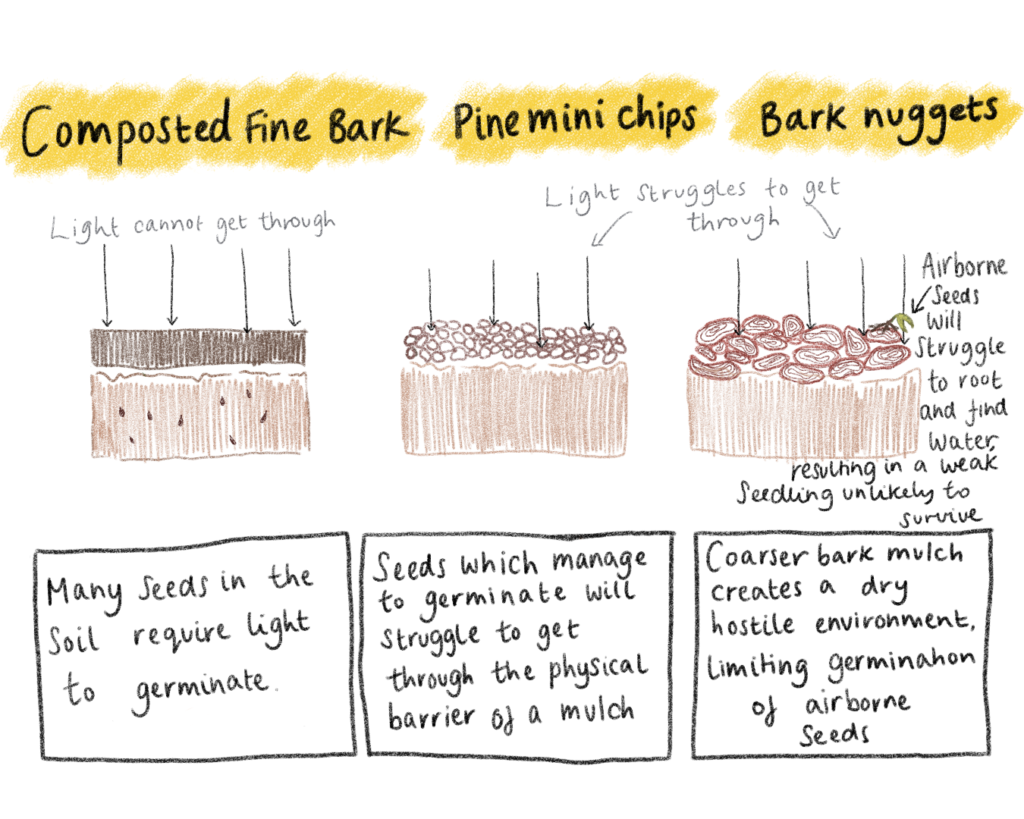
But it is wrong to expect even a coarse bark mulch to prevent 100% of weed growth. There will always be the odd one that survives. But those that do manage to germinate and grow will be fewer in number and easier to remove.
So if this is what a bark mulch can do about weeds, what can it not do?
Bark mulches are not usually able to suppress perennial weeds such as nettles and ground elder. These are too well-established and have reserves sufficient to grow through the mulch – which is rarely dense enough to cause any physical impedance. But happily the same principle applies to the herbaceous perennials that we want to thrive. These will usually manage to push through, as will bulbs.
Moisture conservation – we are told that a bark mulch will help to prevent moisture loss from the soil surface and indeed this is true but in reality it is weed suppression that prevents most soil moisture loss. The roots of a weed can occupy a large volume of soil, sometimes at great depth. As the process of moisture loss through their leaves, called transpiration, takes place it is not difficult to see how their presence speeds up the loss of moisture from the potentially large volume of soil that the weed roots occupy.
By contrast moisture loss from the soil surface is typically relatively minor. When the sun’s rays reach a bare soil, their energy will dry the surface layer in the process we call evaporation. However, once dry, the soil surface itself can act as a mulch, insulating the layers below from the drying effects of the sun. This is particularly true of coarse, sandy soils where the capillary flow of soil moisture up the soil profile is easily arrested as the soil dries. A clay soil with its high content of very fine particles, will show greater capillary flow and is less likely to ‘self-mulch’. Clay soils will therefore benefit more from the evaporation-reducing effects of a coarse bark mulch.

Choosing the right bark mulch
Once we understand how bark mulches work it makes the job of choosing them easier, especially when the particular challenges of the site are considered.
If for example, in situ annual weed seeds are the main problem it’s important that the mulch is applied thickly enough to block out light and this usually means a minimum depth of at least 2 inches / 50mm.
For ongoing performance, keep the mulch topped up as it gradually breaks down. As the bark decomposes, the surface layers of soil also benefit from the addition of organic matter, which can help to conserve moisture.
Longevity and appearance are also important. Spruce bark-based mulches are cheaper to purchase but not as long-lasting as those based on pine bark. Pine bark is the hardest, most resilient of those we have access to in the UK and lasts the longest when used as a mulch.
When aesthetics are important, the choice should also take visual appearance into account. The main differences can be summarised as follows.

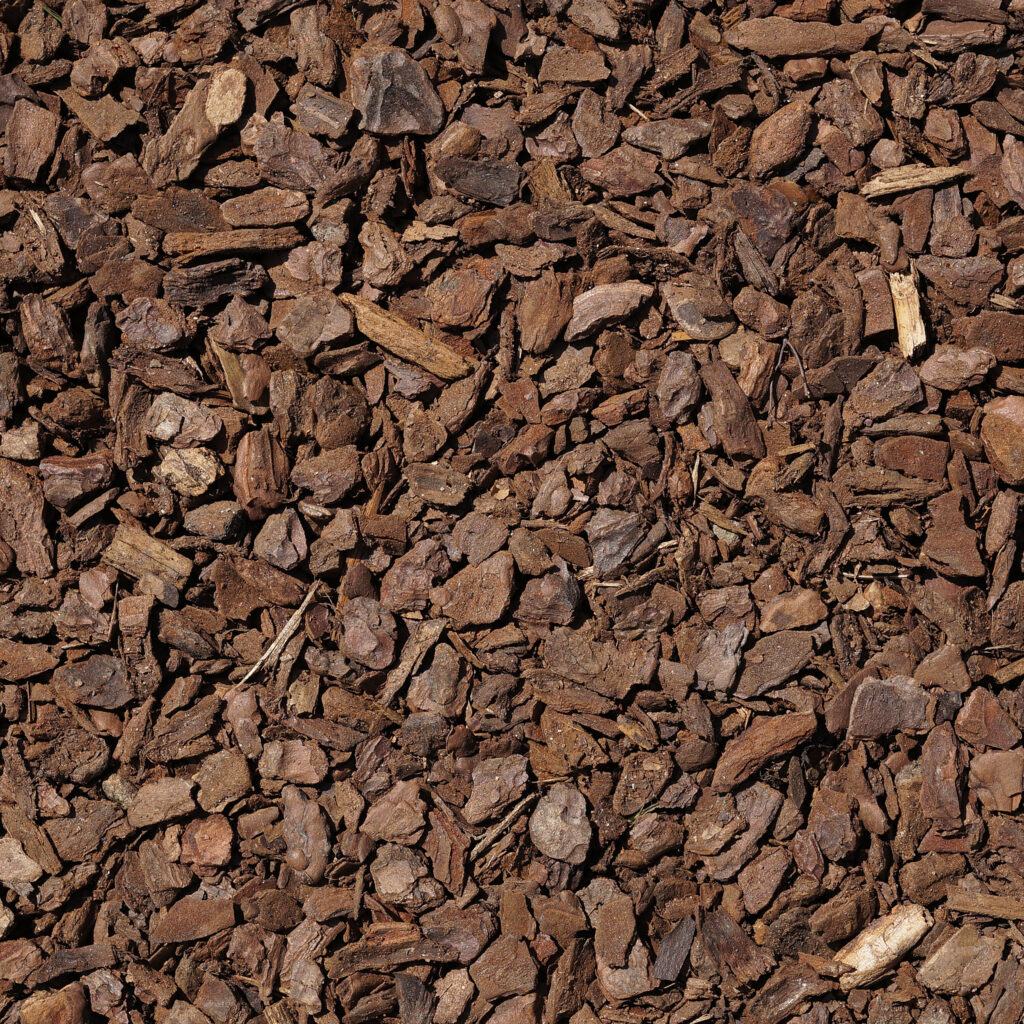

SylvaBark Pine Bark Flake
| Mulch examples | Typical appearance | Longevity | Best suited to |
| Melcourt Spruce Ornamental™ | Dark in colour; may include some wood slivers | Usually two to three years of good service when undisturbed | Cost-conscious schemes where a dark decorative finish is preferred |
| SylvaBark® Pine Bark Flakes | Red-brown colour with a chippier appearance and typically fewer wood slivers | Usually longer lasting than spruce; potentially around double the service life | Longer-term applications where appearance and durability are priorities |
Spruce Ornamental and SylvaBark are just two examples of the very wide range of bark mulches offered by Melcourt. See https://melcourt.co.uk/products/mulches-walk-surfaces/ for the comprehensive range to suit all applications and appearances.
Wood slivers are not harmful in a mulch, so their presence only matters aesthetically.
Using bark mulch effectively
Once the right mulch has been selected, how it is applied and maintained will determine how well it performs.
But it is important in both cases to avoid disturbing the mulch. When laid, a mulch has one interface with the soil surface. Any movement of the bark particles such as cultivating through it will cause the soil with its myriad microorganisms to come into closer contact with more of the mulch and this vastly increases the rate of breakdown. So if planting or cultivations are to happen, good advice is to gently move the mulch to one side and then carefully replace it once the job is completed.
In all cases it is good practice to avoid putting the mulch right up to the stem of trees or shrubs as this can cause damp conditions which is not good for the stems of plants. A separation of just a few centimetres is all that is required.
The best bark mulch choice starts with the site problem: use a coarse, low-fines mulch where weed suppression is the priority, consider pine where longevity matters most, and match the visual finish to the setting. By understanding how bark mulches function, we can make better choices and get the most effective results from the many benefits they bring.